
The Wrong Green
On the vilayati babool, the people who depend on it, and the cost of imported solutions

When I first drove into Ajmer from Jaipur in August 2024 , I was expecting a desert. What I found instead was green - a dense, almost continuous green cover along the roadsides and across the hillsides, more lush than I had anticipated. I remember feeling something close to relief. The landscape looked alive.
I mentioned this to a local, who smiled in the way people smile when they are about to tell you something uncomfortable. “That green,” he said, “is vilayati babool. The foreign thorn. And it is one of the worst things that ever happened to this landscape.”
What I had mistaken for a thriving native forest was, in fact, a biological takeover by Neltuma juliflora, formerly known as Prosopis juliflora, a thorny shrub native to Mexico and the Caribbean that has become one of India’s most complex and underreported ecological disasters. The story of how it got here is a story about good intentions, colonial ambition, and the particular danger of importing a solution to a problem that already had a local answer.
The intentional invader
The vilayati babool arrived in India in 1857, introduced deliberately to halt what administrators of the time were calling the “desertification” of the Thar. By 1878 it had spread to peninsular India, planted specifically to provide fuelwood to communities facing energy shortages. Decades later, the Maharaja of Jodhpur commissioned what must be one of the more audacious ecological decisions in regional history: the aerial seeding of the species across Rajasthan. Aircraft scattered seeds across the landscape from above. Farmers initially welcomed the shrub as a living fence to protect their crops. It was hardy, fast-growing, and asked almost nothing of the soil.
What nobody adequately modelled was what the plant would do once it escaped those fences. Which it did, and quite comprehensively.
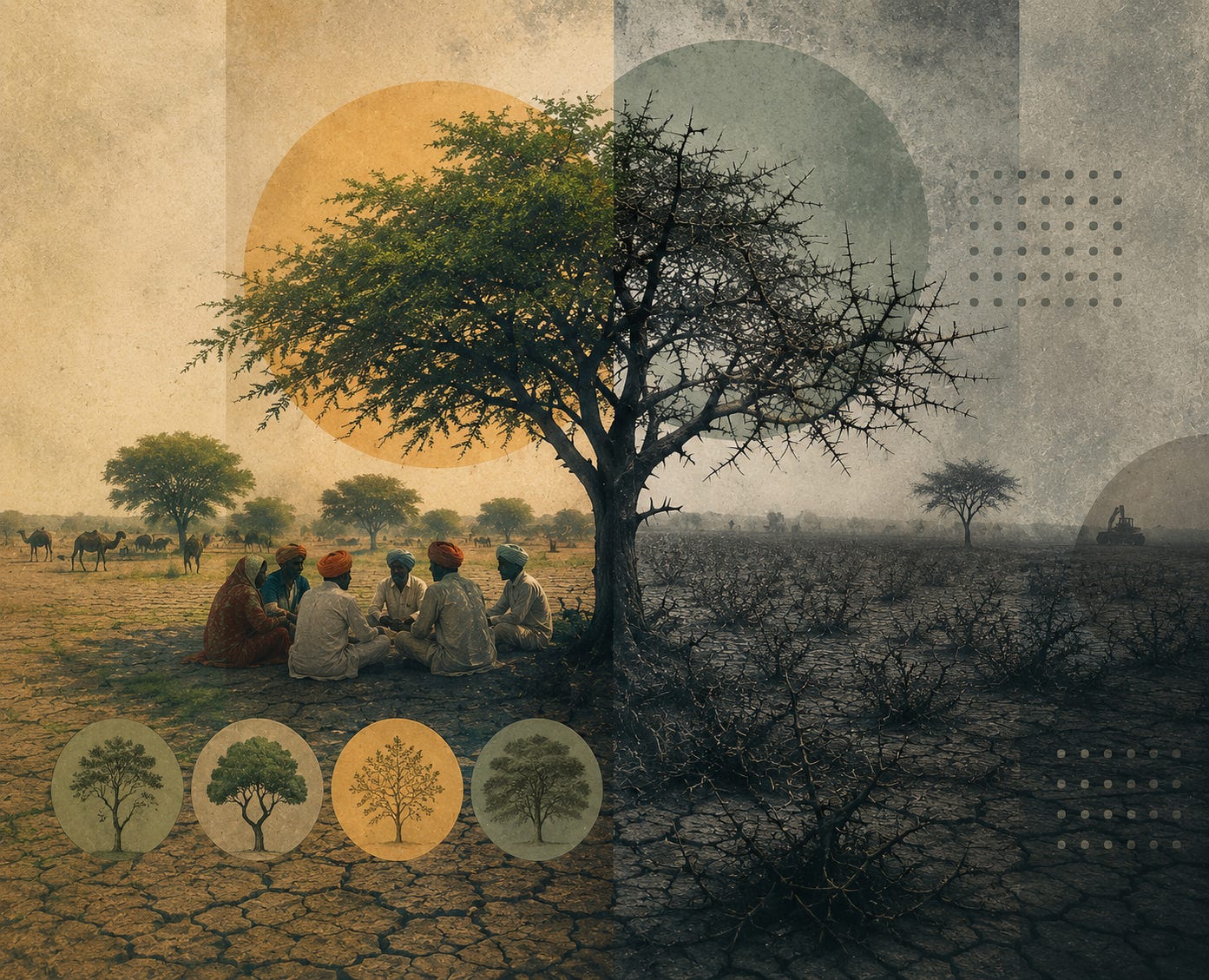
Within decades, the vilayati babool had moved from roadsides into pasturelands, from farmland boundaries into protected nature reserves. Its thorns made it impassable for livestock, cutting off traditional grazing routes. More insidious was its allelopathic effect: the tree releases toxins into the soil that prevent other plants from germinating or growing in its vicinity. The clearing beneath a Prosopis thicket is often a dead zone — nothing else grows. What looked, from the air or from a passing car, like a forest, was in ecological terms closer to a desert wearing a green disguise.
What it displaced
The casualties were not abstract. The Khejri (Prosopis cineraria), Rajasthan’s revered state tree, a species so integral to the landscape that entire communities organised their lives around it, is declining year by year, displaced by its invasive namesake. The Deshi Babool (Acacia nilotica), the Dhok (Anogeissus pendula), the Salar (Boswellia serrata), native species with deep ecological and cultural histories in this region, are suffering similar fates. In Salarmaal, a village historically named for its Salar forests, those trees have almost entirely disappeared, replaced by the invader.
In the Ajmer region specifically, the impact is acute. The village of Ralawatan has seen Prosopis take over 75% of its total land area, including forests and pasturelands. Traditional agriculture in dry reservoir beds, petakasht, has declined by 70%, as the trees block water channels and colonise the fertile silt. The Nandtilora ridge, which once acted as a natural barrier against the shifting sands of the Thar, is losing its effectiveness as Prosopis weakens the native ecosystem that held it in place. The landscape I found enchanting on the road from Jaipur is, in measurable terms, a region in ecological crisis wearing a green coat.
The livelihood paradox
Here is where the story becomes genuinely difficult. Because the vilayati babool, for all its damage, is not universally experienced as a problem. For the landless, for the poor, for communities whose traditional livelihoods have been destroyed by other forces, it has become, however imperfectly, a lifeline.
In Jodhpur district, the Jogi tribe, whose traditional jute business was destroyed by the arrival of plastic, now earns approximately ₹30,000 a month burning vilayati babool to make charcoal. For households where LPG supplies are sporadic or unaffordable, the shrub is the only reliable cooking fuel. Some farmers use the ash from the wood to retain soil moisture for specific crops. The pods, while damaging to cattle, can be eaten by goats and camels, and have been processed into nutritious flour in the Americas.
The uncomfortable truth is that eradicating the vilayati babool entirely would cause immediate harm to some of the most economically vulnerable people in the region. Complete eradication is, as ecologists who have studied this carefully will tell you, neither practical nor just. The species has been woven, however destructively, into the survival strategies of people who had no say in its introduction.
This is the full weight of the imported solution. Not just the ecological damage, but the human dependency that accumulates around it — the way that a bad decision, made once from above, becomes a permanent feature of the landscape of poverty below.
What this means for restoration
The path forward, as with most genuinely complex problems, is not a war but a negotiation, and strategic management rather than eradication. Targeting the invasion front, where the species is actively spreading into new territory, rather than attempting to clear the dense thickets where communities have already built livelihoods around it. Restoring native species like Guggul (Commiphora wightii) and Neem alongside removal efforts, so that cleared land does not simply re-colonise. Turning restoration into employment, drawing on the deep knowledge of local communities who understand this landscape in ways that no outside ecologist fully can.
We think about this every time someone asks why Chhaon wants to use native species first. The vilayati babool story is the answer. It is not a cautionary tale from a distant past - it is happening now, in the landscape visible from the road that leads to our front door. It is the single most instructive example I know of what happens when you import a solution without measuring its consequences, without asking the landscape what it already knows, without giving the people who live there any say in what gets planted above their heads.
Green sovereignty is sometimes treated as a cultural preference, as a romantic attachment to the indigenous over the cosmopolitan. For us, it is a practical position. The organisms best adapted to Rajasthan are the ones that evolved here. The communities best placed to restore this landscape are the ones who have lived in it for generations. Chhaon is being built on both of those propositions - not as as ideology, but as the most rigorous, evidence-based response we know to a problem that bad ideology created.
The green I saw on the road from Jaipur no longer looks like health to me. It looks like a warning. And the only honest response to a warning is to pay attention to it.